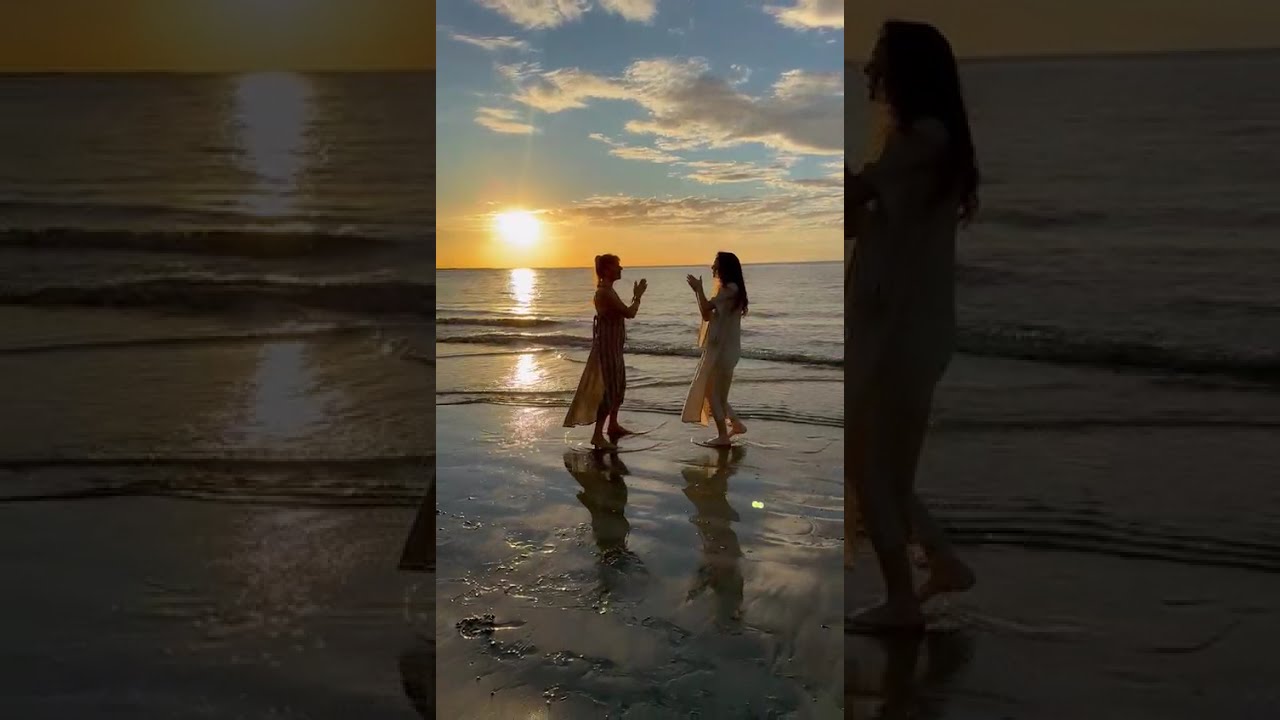
This short devotional performance captures Mirabai Ceiba singing kirtan to Oshun—the Yoruba and Santería deity associated with rivers, honey, sensuality, abundance, and the divine feminine—performed outdoors at the Golden Cathedral in Pine Creek Canyon, Utah, during a Canyon Samadhi Retreat. The setting, nestled in the landscape near Zion National Park, creates an acoustic and spiritual context for invoking a water-based, earth-rooted deity in a place of natural rock cathedrals and flowing stone.
What is Oshun in Kirtan and Spiritual Practice?
Oshun is a primary deity in Yoruba cosmology and Santería (also known as Regla de Ocha), an African diaspora religion that blended West African spiritual traditions with Catholicism during enslavement and colonial occupation. In kirtan—call-and-response devotional singing from Hindu and yogic traditions—Oshun appears as a bridge between African-rooted spirituality and contemporary conscious music practice. She is invoked as the goddess of rivers, fresh water, fertility, love, sensuality, honey, sweetness, and feminine power. Her colors are yellow and gold; her number is five. She is often depicted wearing yellow garments, draped in gold, holding a mirror—a symbol of self-knowledge and reflection.
When a kirtan singer like Mirabai Ceiba chants to Oshun, the practice honors not only Hindu bhakti (devotional) traditions but also acknowledges the spiritual lineages of the African diaspora and their synthesis with yoga and contemporary spirituality. This represents an intentional weaving of traditions that have been historically separated, creating space for cross-cultural sacred practice.
Why Perform Oshun Invocation in a Canyon Landscape?
The Golden Cathedral in Pine Creek Canyon is not a built structure but a natural rock formation—a place where stone has been shaped by water and time into cathedral-like formations. Oshun's primary domain is water: rivers, streams, and the flowing force of change and nourishment. Performing an Oshun invocation in a canyon landscape where water has carved the earth creates a resonance between the deity's nature and the actual geography. The performance becomes not merely symbolic but eco-spiritual—the singer addressing the living presence of river-formed stone, calling on the goddess whose hands shaped the very landscape.
This choice of venue also reflects the philosophy of many contemporary kirtan and yoga retreats, which increasingly situate practice in natural settings rather than indoor studios. The Canyon Samadhi Retreat, held in this location, suggests an intention to merge contemplative practice with direct encounter with landscape. Samadhi—a Sanskrit term meaning absorption, unity consciousness, or complete meditative stillness—is invoked alongside the magnificence of Zion, one of the American West's most visually overwhelming wilderness areas. The juxtaposition asks: What does it mean to seek samadhi while surrounded by geological majesty? How does the body and voice respond to singing in natural cathedrals rather than human-built ones?
Kirtan as Participatory Devotional Singing
Kirtan is a live, call-and-response practice where a lead singer or group initiates a sacred name, phrase, or mantra, and participants echo and sustain it. Unlike concert performances, kirtan is designed to create collective movement toward a spiritual state. The lead singer—in this case, Mirabai Ceiba—holds the container for the practice, often using melodic variation, repetition, and rhythmic structure to deepen participants' engagement.
Mirabai Ceiba, an American kirtan artist and musician, has built a career on devotional singing that bridges Hindu mantra, Sufi sacred music, and global spiritual traditions. Her work often emphasizes the divine feminine and Earth-based spirituality. Recording or performing an Oshun kirtan in such a public setting—a retreat that drew people to experience samadhi in a natural cathedral—positions Oshun invocation as accessible, ecumenical practice rather than esoteric knowledge.
The Spiritual Significance of Invoking Oshun
In Santería and Yoruba tradition, Oshun is associated with multiple spiritual qualities. She is the orisha (divine force or deity) of love and magnetism—drawing people toward what nourishes and delights. She is the guardian of fertility, both literal and creative: the capacity to birth new forms, ideas, and life. She governs sweetness and pleasure, balancing the severity and warrior nature of other orishas. She is a river—fluid, adaptive, carving her own path, persistent in gentle power.
Invoking Oshun in a kirtan context invites these qualities into the practitioner's being. To sing to Oshun is to ask: Where am I rigid? How do I cultivate magnetism and authentic desire? What does it mean to move like water? How do I honor pleasure and sensuality as spiritual, not separate from the sacred? These are the unspoken questions embedded in an Oshun invocation.
The performance at Golden Cathedral also speaks to environmental and feminine spirituality. A goddess of rivers becomes a living prayer for the waters of the Earth—their protection, their vitality, their role as the circulatory system of the planet. In the era this video was published (2013), climate concerns and eco-spirituality were increasingly central to conscious spiritual movements, and invoking Oshun at a river-formed canyon carries implicit ecological reverence.
What Does This Performance Offer?
While the video is brief (2 minutes), it documents a moment of collective invocation. Those present at the Golden Cathedral—whether seated on stone, standing near flowing water, or simply witnessed through the recording—participated in a practice that honors an African diaspora deity within a contemporary yoga and conscious spirituality context. The performance acknowledges that spiritual power is not confined to one tradition, that the divine feminine takes many names and forms, and that sacred practice deepens when rooted in natural places.
The video also serves as an archive—a record that such a retreat occurred, that people gathered to sing together in a place of natural beauty, invoking deities whose lineages reach back to Africa, to ancient Yoruba kingdoms, to the survival and innovation of enslaved peoples. In this sense, the performance is not just devotional but also cultural and historical testimony.
Where to Go From Here
If this performance resonates, explore the following directions: Learn more about Oshun and Santería through books like Oshun Across the Waters (edited by Joseph Murphy) or Women of the Cellar by Yaya, which center African diaspora spirituality and women's experience. Investigate kirtan practice by attending live kirtan at yoga studios or through recorded kirtan by artists exploring cross-cultural invocation. Explore eco-spirituality and place-based practice by researching retreats and teachers who ground contemplative work in specific landscapes. Consider the ethics of cultural appropriation versus cultural appreciation—when is it appropriate to invoke deities from traditions not your own, and how does one do so with respect and knowledge? Reflect on the role of natural settings in your own spiritual practice—how does location shape your capacity for devotion, presence, and transformation?