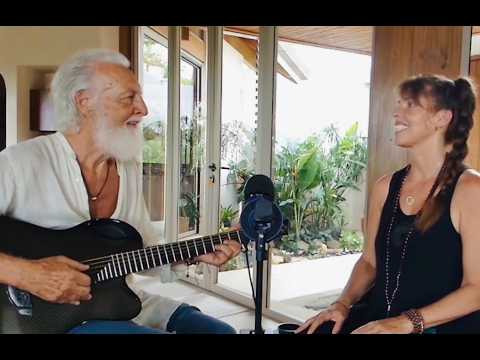
Brahma Nandam is a Sanskrit mantra of devotional salutation to the Inner Guru—the source of wisdom within consciousness itself. Performed live in Byron Bay, Australia in 2005, this mantra from the album Dakshina demonstrates how chanting sacred sounds can attune the mind and heart to guidance that exists beyond the intellect, dissolving the boundary between worshiper and the divine principle being honored.
What is Brahma Nandam and why does it matter?
Brahma Nandam is a devotional mantra rooted in Sanskrit and Hindu-Buddhist spiritual traditions. The word "Brahma" refers to the ultimate reality or divine consciousness, while the structure of the mantra creates a salutation—a bow of reverence toward something transcendent. In the context of this practice, the Inner Guru is not a person but rather an awakened principle of wisdom that exists within the seeker's own consciousness. Unlike external teachers who transmit knowledge through words, the Inner Guru operates through direct insight and intuition.
The significance of chanting such a mantra lies not merely in intellectual understanding of the words, but in the vibrational and psychological effect of repetition. When practitioners engage with Brahma Nandam, they are not simply reciting Sanskrit syllables; they are using sound as a technology to reorganize attention and open the heart toward recognizing wisdom that is always present but often obscured by mental chatter and habitual thinking patterns.
How does sacred sound function as a spiritual practice?
In mantra practice, each sound carries frequency and intention. Sanskrit, the language in which Brahma Nandam is composed, was historically understood by practitioners as a language where the sound itself reflects the nature of what is being invoked. Unlike modern languages where the connection between word and meaning is largely arbitrary, Sanskrit mantras operate on the principle that the vibration of the sound embodies the quality being called upon.
When Deva Premal and Miten perform Brahma Nandam, they are working with this understanding. The repetition of the mantra creates a rhythm that can stabilize a scattered mind. As the voice resonates through the body and the room, the nervous system begins to entrain—to synchronize with the frequency being produced. This is not mystical or metaphorical; it is a demonstrable phenomenon in which sustained sound patterns influence brainwave activity and parasympathetic nervous system tone.
For a listener or practitioner, the experience of hearing or chanting Brahma Nandam can feel like a direct transmission. The musicality and devotion brought by trained singers like Deva Premal and Miten amplify this effect, because their practice and intention infuse the sound with a quality that can be felt even by those unfamiliar with Sanskrit.
What does saluting the Inner Guru mean in practice?
The Inner Guru is a concept found across Buddhist and Hindu non-dual philosophies. It points to the idea that ultimate knowledge or awakening cannot be transferred from one person to another like information; it can only be recognized by oneself. A human teacher can point the way, create conditions, or remove obstacles, but the actual seeing must occur within the student's own awareness.
Saluting the Inner Guru through mantra is therefore an act of surrender to one's own highest potential and deepest knowing. It is a gesture of humility that says: "I acknowledge that my real teacher is not only external but also the awakened intelligence within me." This salutation is not flattery or superstition; it is a practice of recognition—of bowing to the truth that sees through one's own eyes.
In the context of a live performance like the one recorded in Byron Bay, the mantra becomes a shared invocation. The audience and performers together create a field in which this recognition can occur. Even for those who may not consciously believe in an Inner Guru, the repetitive, devotional quality of the chanting can create a psychological and spiritual opening—a softening of the boundary between self and other, between subject and the truth being sought.
How does the album Dakshina frame this mantra?
Dakshina, the album from which Brahma Nandam is drawn, is built on the concept of sacred offering. In Hindu and Buddhist traditions, dakshina refers to a gift given to a teacher or to the divine as an expression of gratitude and devotion. By framing the album with this title, Deva Premal and Miten situate their music not as entertainment or mere aesthetic experience, but as an offering—a giving back to the source from which all wisdom and spiritual guidance arise.
This contextual framing matters because it shapes how a listener might approach the music. Rather than passively consuming the performance, one is invited into a relational stance: the act of listening becomes itself a form of offering, a recognition that receiving from the Inner Guru is only possible when the heart is open and humble.
What is the role of the live performance setting?
A live concert, especially one recorded in a sacred or spiritually attuned setting like Byron Bay (a known center for spiritual community in Australia), creates different conditions than listening to a studio recording. The presence of other practitioners and seekers generates a collective field. The spontaneous elements of live performance—the breath of the singers, the energy of the moment, the acoustic properties of the specific space—all contribute to a unique transmission that cannot be precisely replicated.
In such a setting, Brahma Nandam functions as both individual and collective practice. Each listener can resonate with the mantra privately, through their own heart; simultaneously, they are held within a larger container of shared intention and devotion. This simultaneity of individual and collective experience is one of the unique gifts of congregational mantra practice.
Can secular practitioners benefit from Brahma Nandam?
While Brahma Nandam emerges from specific spiritual and philosophical traditions, its benefits are not restricted to those who identify with those traditions or who hold particular beliefs. The neuroscience of sound, breath, and repetition applies across worldviews. Someone approaching Brahma Nandam as a meditation or relaxation practice—without endorsing any metaphysical claims about gurus or Inner Consciousness—can still experience the calming, centering effects of sustained chanting.
That said, the full depth of the practice is likely to open more fully when approached with at least openness to its traditional meaning. The mantra was composed by people within a lineage of practice, and it carries intentionality and wisdom built up over centuries of use. Approaching it with curiosity and reverence—even if one's personal cosmology differs from the traditional one—allows the practice to work on its own terms.
Where to go from here
For those drawn to explore Brahma Nandam further, the most direct path is to listen to and, if called, to practice chanting the mantra oneself. Deva Premal and Miten offer recordings and live teaching through their Gayatri Sangha App, as well as through tours and their broader musical catalog. Beginning with simple repetition—even humming or singing along with a recording—can begin to attune the nervous system and the heart to the frequency of the practice.
Reading about the philosophical background of the Inner Guru in non-dual traditions (such as Advaita Vedanta or Dzogchen Buddhism) can deepen intellectual understanding, though understanding itself is not the goal; direct experience through practice is what transforms. Many spiritual teachers offer guidance on mantra practice and on the specifically devotional approach to recognizing one's own highest nature.
The invitation of Brahma Nandam is ultimately simple: to pause, to listen, and to bow—whether outwardly or inwardly—to the wisdom that is closer than thought, already present, waiting only to be acknowledged.